

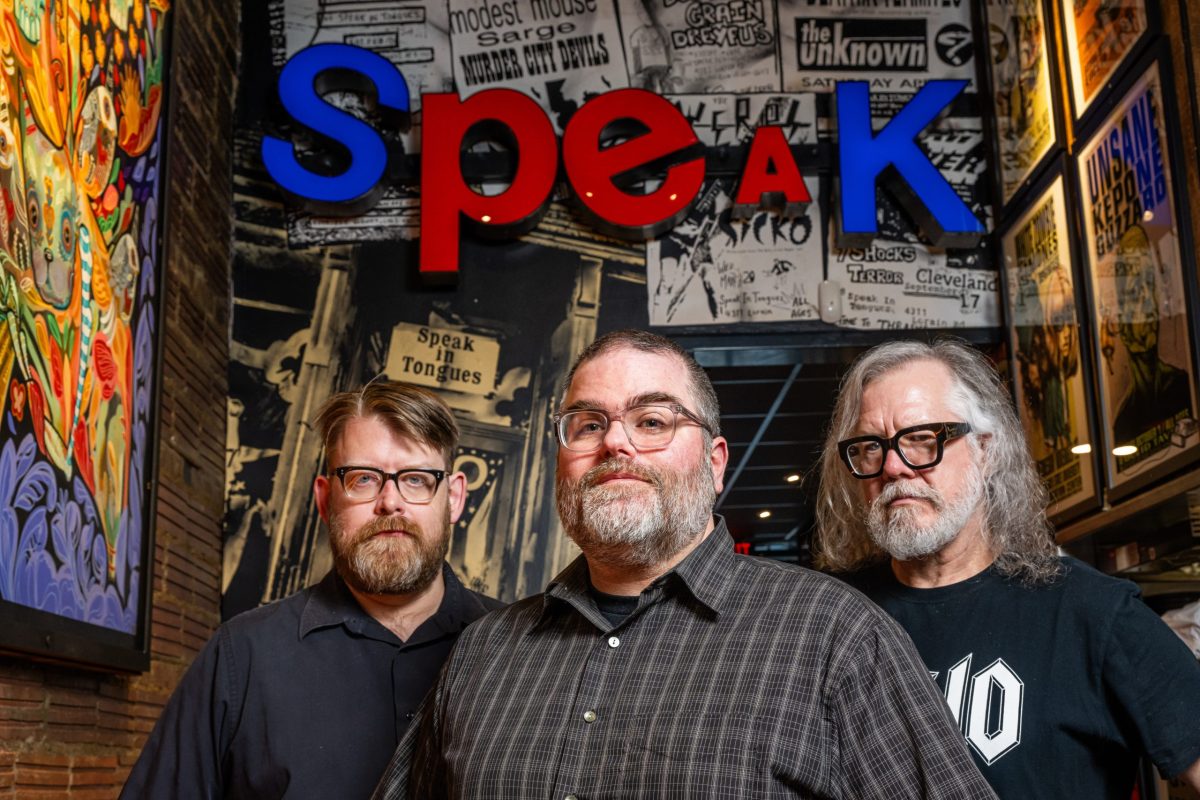
From 1994 to 2001, Speak in Tongues served as Cleveland’s DIY outpost for unrestricted creative expression. The space hosted the city’s debuts by then-unknown acts such as Modest Mouse, Godspeed You Black Emperor!, Neutral Milk Hotel, U.S. Maple and hundreds more bands, artists, filmmakers and other creatives.
A new book, Where Shit Happened: The Paper Trail to Speak In Tongues, documents Speak in Tongues’ history with over 500 pages of fliers, photos, newspaper clippings and other preserved ephemera.
At 8 p.m. on Friday, Aug. 14, Spotlight Cleveland will host a pre-party gathering featuring performances by five bands whose members had close Speak in Tongues connections: AWESOME*QUEST!, Murderous Vision, Blue Antidote, the Stephe DK Band and Heavy Rains Stringband.
On Saturday, Aug. 15, Visible Voice will host the book’s official release. The event will start at 3 p.m. with a performance by Uno Lady, Cleveland’s one-woman choir. A panel discussion will follow at 4 p.m., moderated by Cleveland historian John Skrtic, featuring SIT archivists Sean Carney and Ken Blaze, former SIT residents Danny Noonan and Jake Kelly, and book creators John Delzoppo and Ron Kretsch. Later that night at 9 p.m., Happy Dog will feature a lineup including Harriet the Spy, Beckett and Friends, and Applejuice, all closely associated with SIT.
John Delzoppo, Jake Kelly, and Ron Kretsch, all of whom worked on the book, recently met at Proof Public House to discuss the project.
How did the idea for the book come about?
Delzoppo: I guess the origin was cleaning up my closet and sorting through old fliers, noticing that I had a bunch from Speak in Tongues and appreciating how different they were from each other. There was a lot of variety, despite being from the same place and time period. It got me thinking it would be fun to expand the collection, so I reached out to a few friends, including Jake, to see what they had. It started to take shape from there.
Kelly: John had been doing a weekly Flier Friday post on Instagram. I was working on flier books of my own at the time and while I was looking at one of his posts I thought, “I would like to see a Speak in Tongues flier book.” Five minutes after I had that thought, John texted me and asked if I’d want to publish a book of them. It seemed like a natural “yeah.”
Can you each talk about how you were involved with the club?
Kelly: The first time I went to Speak in Tongues was when I was playing a show there. It was early on, like in the first 6 months. I was instantaneously intrigued by the place. It was unlike any other club. Then, I just started going there as much as I possibly could. My friend Danny and I lived in the Western suburbs. He was in Rocky River, and I lived in Fairview. We used to ride our bikes down Lorain all the way to Speak in Tongues. That Walrus statue at the library at 117th was our half-way demarcation point. I was still in high school and went to see Crash Worship, and the show got out at 4 in the morning. I went home and took a shower and went to school, and I remember sitting in study hall and going, “I am done with all of this. I’m dropping out of high school.” I barely graduated. After high school, I lived in a couple of different places, and the guys from the band Grain, who lived at Speak in Tongues, were moving out. I moved in, and I was there on and off for a few years. At a certain point, you have to get out of the Speak in Tongues basement, so I was living upstairs for a while, and then right down the street. It was a huge part of my life until I moved to New York, and then it closed three months later.
Kretsch: The guy who ran the Pieta upstairs was a roommate of mine in college, so I was used to going to that building to see shows. When Speak in Tongues opened, they booked a lot of the kind of stuff I liked. Much of it was stuff that regular clubs didn’t want to do because you couldn’t sell a lot of beer at shows like those. There were always spaces that would do those types of shows, but Speak in Tongues weirdly seemed the most stable. At Speak in Tongues, you walked in the door, and you could tell it was different. It was its own thing, it was home to more than one scene. Euclid Tavern was one scene and one kind of music. I loved that scene, but Speak in Tongues was all over the place, and that was more exciting.
Kelly: It’s a “blind man and the elephant” thing. People often say it was the home of the noise scene, or it was where all the emo bands played, but it was a lot of things all at once.
Krestch: I was also a musician and played there a bunch. When it became a cooperative, I joined the collective as soon as it was a possibility.
Delzoppo: I started going there the summer before my senior year of high school. A few friends who were more involved in the scene started taking me along to the Grog Shop, Euclid Tavern, VFW Halls, and some shows at Speak in Tongues. I felt a strong connection to Speak quickly because it was so different. It was hard to process what it actually was on my first few visits. I just didn’t have a reference point for it, which was exciting. It felt like a place where anything unexpected could happen on any given night. It was just a very special place to be exposed to a lot of new music you couldn’t hear anywhere else.
Kretsch: There is a lot about the place that comes down to vibe. You hear it a lot from people that the first time they went there they felt something. There have been a lot of show houses, and there still are, but I don’t think there will be three books about the Tower. And that’s not a slam, I liked that place, too.
Delzoppo: The lore is so massive and we’re still talking about it for a couple main reasons. For one, it truly pulled in world-class artists from many different scenes to this one place that was kind of separated from reality. And it ran for seven years, an eternity in terms of illegal DIY venues. The best of many worlds were converging in one place, and it ran long enough to make a lasting impact.
Kretsch: Never once did it cross my mind that it was illegal.
What kinds of challenges did putting this book together present?
Delzoppo: The biggest challenge was finding the individuals who had the pieces I was missing to fill in the gaps. Reaching out — either directly or by proxy, hoping for a response, then continuing to remind them to look through their stuff and get it to me. All the tedious legwork comes with a very real level of mental exhaustion. I’m not great at being a pest, but the nature of this project requires it. I really had to overcome my own politeness, badgering people to keep looking and send what they found. In most cases it eventually paid off, but there were a lot of dead ends that still irk me when I think about pieces that never turned up.
Kelly: Almost everyone who saves fliers also has interesting photos. Initially, it was like, “Okay, we’ll include a few photos.” Then, it became, “Okay, we’ll include two or three hundred photos.” The size of the book kept expanding, but somehow never felt big enough to include everything.
Kretsch: For a flier book, there were a lot of photos of shows for which we had no fliers. It kind of ballooned into a different project with the material we received really dictating the scope of the book.
What was it like to do the layout?
Kretsch: It was a lot. The last really visual coffee table book I did was 300 pages. That was slim compared to this one. John and I talked about how every spread has to be its own work of art. You’re addressing a different subject on every page, but they are all thematically linked. It was a matter of creating 250 really complex spreads.
Delzoppo: And puzzling everything together while trying to treat every piece with the care it deserves. Looking at fliers or photos from legendary gigs that are still talked about 30 years later, we wanted to give them their deserved real estate without shortchanging other things. Five hundred fliers can’t all have their own full page, so it was a constant balancing act between significance and available space. This was initially just going to be a flier book, but I wanted people who’d never been there to get a feel for what it was like, and the photos really help to paint the full picture.
Kretsch: The first chapter is really heavy with broad photos of the space. We needed to give a sense of what it was like to be in there, to shape the context for the rest of it.
Kelly: For a book with no words, there is a lot of narrative drive, especially in sequential photos. There is also a lot of humor. There are funny page turns and humorous punctuation in the form of a photo or flier. It’s dense. For an art book, you sit, and you read it.
Delzoppo: The goal was to bring someone into that world and tell the story from start to finish. I felt like the only way to really accomplish that was to lay it out chronologically. That added a ton of extra work to get everything in its proper place, but without sticking to the timeline it would have been too chaotic — both to create and to digest.
What are some of your best memories of the place?
Kretsch: There are hundreds.
Delzoppo: I was in a band called Oblongata at the time, and Speak was the first actual venue we played. As a young band, getting to play there felt like the older cool kids inviting you into their inner circle. Mike Rodemann and Sean Carney liked what we were doing and invited us to play some shows they were booking. We were honored to be included and it gave us a lot of confidence. It wasn’t the kind of place where local bands would submit demos to get on shows, so it felt special just to be welcomed into the fold.
Kelly: There were a ton of amazing bands that played there that always blew your hair back like Lightning Bolt and Federation X and Crash Worship, so it’s hard to pick favorites. One that stands out was a noise band from Pittsburgh called the Warlocks. It was a bass player and French horn and drummer and some guy making noise on something. Their whole set lasted four or five minutes as part of a big day-long noise thing. They came out and exploded. I probably looked like the guy in the old Maxell commercial. The singer shoved a bunch of newspaper into a toaster and turned it on, burning newspaper flying out. He ran from the stage to the front wall, which was a fake thin wall. He jumped off the couch and onto the wall, and it bent down to where it almost touched the front glass and it sprung back, and he went flying through the air and landed, and there was fire everywhere. It was a good thing I was 22 at the time, and it didn’t register as something that was really dangerous. I remember thinking, “This is our house. What are we doing here?” There were tons of shows like that.
Delzoppo: I’m sure everyone who went there has a mental inventory of their craziest experiences. The oral history book that Microcosm published touches on a lot of that. With my book, I wanted it to be more objective and less story-based.
Kretsch: One person’s totally insane show is another person’s average Tuesday. One non-show night, a bunch of us were just hanging out there. I don’t know why this happened, but there were golf clubs, so we turned the place into an ad hoc mini golf course. We played putt-putt all night using bullshit around the room as obstacles.
Delzoppo: It’s a shame there are no photos of that.
What fliers are some of your favorites?
Kelly: For me, I had done cut-and-paste fliers for my friends in high school and would occasionally draw a flier. I started drawing fliers when I was living at Speak in Tongues. Now, I am in year 30 of making fliers. There is a Wolf Eyes flier that I drew, and that’s one I showed to Kathy [Blackman] at the Grog Shop and Cindy [Barber] at the Beachland that convinced them to let me start doing fliers for their clubs which lined up every other domino in my life.
Delzoppo: In 1998, Al Karpinski from Six Parts Seven had a unique style of fliers he was making at the time. There’s a Bedhead one, Ariel M, Songs Ohia and some others. They were very simple two-color fliers he made on his night shift at Kinko’s, featuring hand-stamped lettering and simple imagery. They’re super clean and bold. Their simplicity makes them stand out and they match the music really well — the perfect aesthetic for the vibe of those bands. On the other side of the spectrum, I love all of Shaun Filley’s hand-drawn cartoonish violence fliers, especially the first one he drew for Spazz in 1997. It was important to me to get a wide variety of favorites in the flier collage on the cover.
The club abruptly closed in 2001. What would you hope someone who never went there gets out of the book?
Delzoppo: I hope it can be something like the experience I had with the Jabberjaw book, It All Dies Anyway, covering the legendary ’90s venue in L.A. They made a beautiful hardcover document with fliers and photos covering the history of the place. Jake gifted me a copy early in this process and it was really inspiring. Even though I never went there, I can flip through that book and get a clear idea of what it was like. I would hope that someone could pick up our book and have that same kind of feeling. Even if they’ve never been to Cleveland or weren’t alive in the ’90s, they can get an idea of why it was important and holds significance. And for the folks who did spend time there, I hope it can open their eyes to everything they missed that was happening in parallel with their time at Speak.
Kretsch: I say this in the book: I wanted the experience of flipping through the book to be as overstimulating and chaotic as it was to exist in the space. I think we accomplished that.
Kelly: The only thing that’s missing is the smell.
Kretsch: We talked about scratch and sniff.
Delzoppo: Sadly, the logistics of scratch and sniff cards just didn’t work out.
Follow us: Apple News | Google News | NewsBreak | Reddit | Instagram | Facebook | Twitter | Or sign up for our RSS Feed
